
Collect, Store, Analyze, and Act
It’s 6 AM. Do you know what your agents did last night?
Your agents ran all night. You got a pull request and a bill. What happened in between, what they spun on, what they threw away, whether last week’s fix held, is sitting in transcripts nobody reads.
HypAware reads every agent session and shows you exactly what’s broken, the evidence, the fix, and whether it stayed fixed.
You already have the data. Using it is the problem.
Get started today in 5 minutes for free. Local open source or HypAware Cloud.

Collect. A small daemon on your machine hooks into Claude Code, Codex, Cursor, OpenClaw, Hermes, etc. and records every session. Nothing else to instrument.
Store. Sessions land as open table files, indexed and linked into a graph of what touched what: sessions, files, tools, skills. No warehouse, no ingestion pipeline.
Analyze. SQL and grep narrow millions of sessions to the ones that matter. Then a model reads those and comes back with findings, each with linked evidence, and the root cause fix for each.
Act. Your agent applies the fix. The next pass checks whether the finding is still happening, so a fix that quietly stopped working gets caught instead of assumed.
You’re flying blind, and the buck stops with you.
Tokens go in. Code comes out. What happened in between is in the session transcripts, on laptops and in the pipelines where agents run unattended, and it’s being thrown away every day.
- What did the factory do overnight?
- It ran for hours and left you a result. Whether that took three attempts or thirty, nobody knows.
- How often does the model need correcting?
- Retries, failed tool calls, tools written and thrown away, work that produces nothing.
- Did your fix hold?
- You found the problem, wrote the skill, shipped it. Then you stopped looking. So did everyone else.
- What is the rest of the team doing?
- Probably the same wall you hit last week. Nobody knows, because nobody reads the transcripts, and nobody can see the whole team’s sessions in one place.
Your tools can’t process that volume, it’s scattered across machines, and it’s being deleted. So nothing improves.
HypAware is the improvement loop for your coding agents.
Not a dashboard. Not observability. HypAware records every session your agents run, reads all of them, and hands your agent the fix. Then it checks that the fix held. Every pass makes the next one better.
- Evidence, not opinion. Every finding links to the sessions and data it came from. Durable and inspectable.
- Findings, not dashboards. What happened, how many times, and what impact it had. Not a chart you have to interpret.
- Recommendations, not observations. The root cause, and the skill, tool, or environment change that fixes it. Your agent applies it.
- Verify it stays fixed. Every pass re-checks the previous findings. Agents change, models change, skills rot. A fix that quietly stopped working gets caught.
Observability shows you what happened, and you have to figure out how to fix it. HypAware finds the root cause, produces a fix, and checks that it works, now and later.
Start now
Get started collecting for free in five minutes. Deploy the collector on your machine alongside your developer tools. Requires Node.js version 22.12 or higher.
Install HypAware.
npm i -g hypaware
hyp setup
Stop throwing away your session data. Start fixing your agents today. Free and open source, running against the sessions you already have. Works whether you have a Cloud account or not.
Ready to join your team and get more?
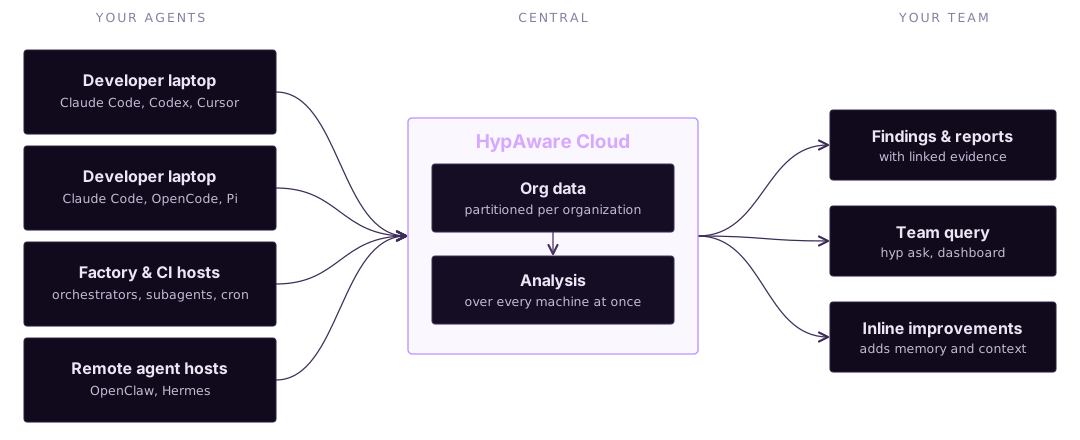
hyp remote loginHypAware Cloud unlocks capabilities beyond a local deployment. One person can sign in and sync on their own. An organization unlocks even more. To set up an organization for your team, contact us at hypaware.ai/contact.
- The whole team and fleet. Every developer’s sessions, the software factory, agents on remote hosts, and the jobs that run unattended, in one place, and findings across all of them instead of one laptop at a time.
- Visualization and exploration. Historical trends, reports, recommendations, findings you can browse, and the sessions behind them, all without writing a query.
- Sharing and collaboration. Share findings, fixes, and new skills across the team to improve together.
- Hosted, at scale. Fully managed deployment, secure, hassle free. And analysis that runs on our side, over everything you have collected across every machine.
Like what you see but need a private instance of HypAware Cloud?